Class 10th - Complete Science - Foundation Chemistry
Watch Video
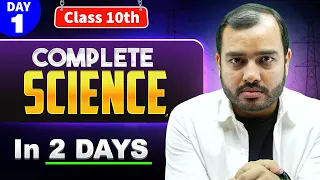
Class 10th - Complete Science - Foundation Chemistry
Complete Science Revision: Key Concepts and Exam TakeawaysChemical Reactions and Equations A chemical reaction involves the transformation of reactants into products, often represented by a chemical equation. Balancing c…

Alakh Pandey - Class 9th & 10th
Summary
Complete Science Revision: Key Concepts and Exam Takeaways
Chemical Reactions and Equations A chemical reaction involves the transformation of reactants into products, often represented by a chemical equation. Balancing chemical equations ensures the law of conservation of mass is satisfied, meaning the total mass of reactants equals the...
Full summary available in the Pi Lens app.
Watch video
Class 10th - Complete Science - Foundation Chemistry
Quiz
Which sequence should be followed when balancing a chemical equation according to the recommended method?
First metals, then non-metals, then oxygen, then hydrogen
Which salt will turn blue litmus red?
Ammonium chloride (NH4Cl)
PYQs
Which sequence should be followed when balancing a chemical equation according to the recommended method?
First metals, then non-metals, then oxygen, then hydrogen
Which salt will turn blue litmus red?
Ammonium chloride (NH4Cl)
Flashcards
What is dispersion of light?
Dispersion is the splitting of white light into its component colors (VIBGYOR) when passing through a prism. This phenomenon occurs because different colors of light have different refractive indices in a medium, causing them to bend at different angles.
Explain why stars twinkle but planets do not.
Stars twinkle because they are distant point sources of light, and their light undergoes continuous, variable atmospheric refraction due to fluctuating atmospheric density, causing the light reaching the eye to fluctuate. Planets, being closer and extended sources, do not twinkle as light from different parts averages out, preventing the twinkling effect.
Quiz
15 QuestionsPick an option to submit
Question 1 of 15
PYQs
15 QuestionsPick an option to submit
Question 1 of 15
Flashcards
38 CardsTap to reveal the answer